
At Medford Gospel Mission, we believe poverty and brokenness are deeper than a lack of material resources. Poverty affects the whole person and touches the relationships God created us to enjoy.
That is why our Relational Restoration Process focuses on what we call the Four Key Relationships: our relationship with God, with ourselves, with others, and with creation.
These relationships are closely connected. Sin has brought brokenness into all of them, and restoration means learning to live more faithfully in each one.
One of the relationships that can be easy to overlook is our relationship with creation.
When we talk about creation, we mean much more than caring for the world God has made. God created human beings to live actively and responsibly in His world. From the beginning, people were given meaningful work, responsibility, creativity, and stewardship. We were created not simply to consume what the world provides, but to cultivate it and contribute to the good of others.
For the men and women in our program, learning to see themselves as contributors is an important part of restoration.
One way they practice this is through the Mission’s ongoing involvement with the Medford Food Project.
The Medford Food Project began in 2011 when a small group of local residents developed a simple way for neighbors to regularly donate food to local food banks. It has been an important community partner of the Mission since the beginning.
The Food Project is built around a simple idea: neighbors working together to help people in their community who do not have reliable access to enough food. Food donors fill green bags with nonperishable food. Neighborhood Coordinators collect those bags every other month, and volunteers help unload, move, and organize the food before it is distributed through local food banks.
The Food Project describes itself as an all-volunteer organization and reminds volunteers that every job is essential. It takes many people working together to make the project succeed.
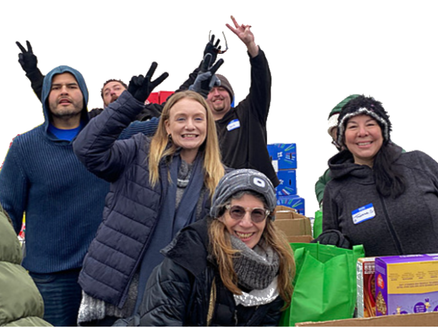
Every other month, men and women from Medford Gospel Mission become part of that effort. They help unload cars, move bags of food, sort donations, and work alongside other volunteers from throughout our community.
What makes this especially meaningful to us is the role they are filling.
People experiencing poverty or homelessness are often viewed primarily as recipients—people who need something from the community. There are certainly seasons when all of us need help, and receiving help is a normal part of living in community. But receiving is never the whole story of a person. God has also given people gifts, abilities, experience, and something meaningful to contribute.
At the Medford Food Project, our participants are part of the solution.
They are not simply standing at the end of the process waiting to receive food. They are helping make the entire process work. Cars need to be unloaded. Bags need to be moved. Food needs to be sorted and organized. Without people willing to do that work, the project cannot accomplish its purpose.
Our men and women become important parts of the engine that makes it run.
That matters because biblical restoration includes recovering a proper understanding of who we are in God’s world. Every person is created in the image of God, with gifts, abilities, responsibilities, and something meaningful to contribute.
This is one of the important lessons of our Relationship with Creation. We want participants to ask not only, “What do I need?” but also, “What has God entrusted to me, and how can I use it for the good of others?”
Sometimes that means employment. Sometimes it means caring faithfully for a home, developing a skill, helping a neighbor, serving in a local church, or simply carrying out ordinary responsibilities well.
And sometimes it means standing beside a line of cars on a Saturday morning, unloading bags of donated food so that someone else in our community can eat.
In moments like these, all Four Key Relationships begin to come together.
Participants strengthen their relationship with creation through meaningful work, stewardship, and contribution. Their relationships with others grow as they serve side by side with members of the community. Their understanding of themselves can also change as they recognize that they have abilities and something valuable to offer.
Ultimately, we want all of these relationships to be shaped by a restored relationship with God through Jesus Christ.
This is why service is an important part of our program.
We do not want people to leave Medford Gospel Mission merely having received more things or more services. We want them to increasingly understand who God created them to be and how they can faithfully participate in His world.
The Medford Food Project gives our men and women a simple but meaningful opportunity to practice exactly that.
They come not only to receive.
They come to work, serve, and contribute.
They come as part of the solution.
If you would like to become part of the Medford Food Project yourself—as a food donor, Neighborhood Coordinator, or volunteer on its support team—visit: medfordfoodproject.com to learn how you can get involved.
Partner with us in God’s work of relational restoration.