
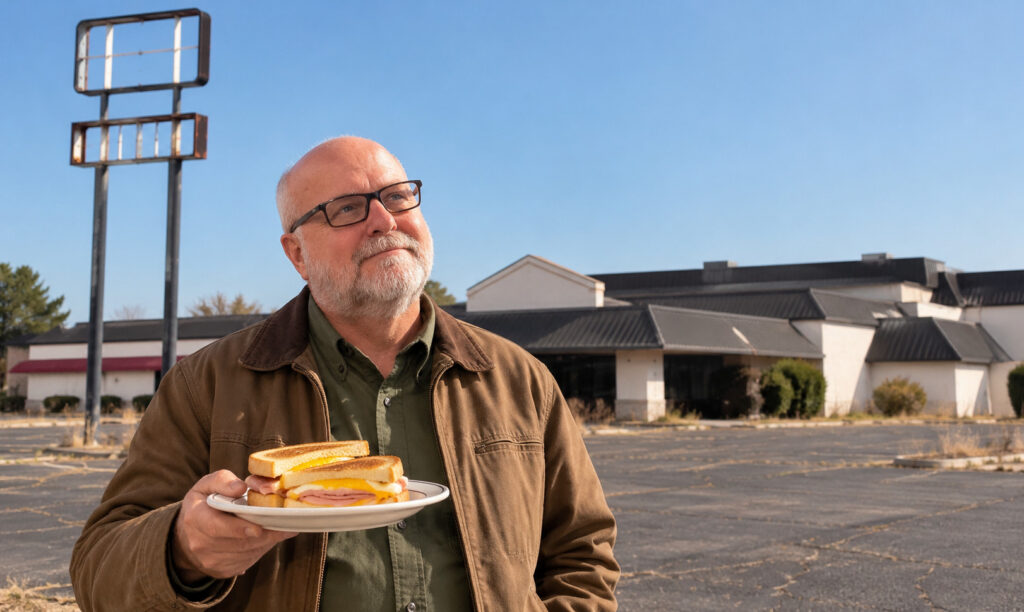
My memories of the old Ramada property go back to dining at the Hungry Woodsman Steakhouse around the turn of the century, and then Denny’s years later, where I could always get a late-night Moons Over My Hammy.
Today, the property is almost unrecognizable. The once-busy hotel and convention center, along with its popular restaurants, has become an abandoned property plagued by fires, vandalism, and unauthorized occupancy. The City of Medford is now pursuing the possibility of acquiring the property through eminent domain.
How did we get here?
The property’s history as a hotel dates back to 1968, when it opened as a Holiday Inn. Since then, it has changed names and owners several times and experienced its share of challenges as the building aged, roads were realigned, and newer hotels were built throughout the area. Its last major change as a hotel came in 2006, when new owners took over and renamed it the Ramada Inn & Convention Center. (1)
For years, the Ramada continued serving travelers and hosting meetings and events. But operating an aging hotel came with challenges. Then COVID-19 arrived in 2020, hitting the hospitality industry particularly hard. In Medford, citywide hotel occupancy dropped from approximately 70% in 2019 to just 53% in 2020. (2)
In September of that same year, the Almeda Fire devastated our community, destroying thousands of homes and displacing families throughout the Rogue Valley. Almost overnight, Southern Oregon faced an extraordinary need for temporary housing.
Enter Fortify Holdings.
Fortify Holdings was a Portland-based real estate developer pursuing a business model of purchasing older hotels and motels and converting them into residential apartments. (3) The company saw an opportunity in Medford, where a longstanding shortage of affordable housing had been compounded by the displacement of hundreds of people following the Almeda Fire.
Beginning in late 2020, Fortify moved to acquire four Medford properties: the Inn at the Commons, America’s Best Value Inn, Econo Lodge, and the Ramada Inn. The purchases were completed over the following months, with the Ramada acquisition finalized in April 2021. (4)
The company’s plan was to convert these properties into long-term residential apartments, providing lower-cost housing in a community where affordable rentals were increasingly difficult to find. All four properties were taken out of conventional hotel operations and converted, or slated for conversion, into residential housing. Each received a new name, and the Ramada became The Loring. (5)
But there was an additional opportunity—and a challenge. Some of these properties, including the Ramada, were already providing temporary accommodations for people displaced by the Almeda Fire. The state needed those families to remain safely housed while longer-term solutions were developed, and Fortify had properties that could potentially meet that need.
Working with state agencies and local nonprofit partners, Fortify became part of the effort to house wildfire survivors. The arrangement brought together three parties: a private developer providing the properties, nonprofit organizations coordinating housing and services, and government agencies helping fund the assistance.
Fortify owned the buildings, but that didn’t necessarily mean it operated the housing programs within them. In some cases, nonprofit organizations leased apartments from Fortify and made them available to eligible residents. Other organizations helped arrange housing placements, rental assistance, and supportive services.
Government funding helped pay housing costs for some residents, particularly those displaced by the Almeda Fire. This meant public money could ultimately flow to a private property owner through rent payments, even though the government didn’t own the buildings. Each party had different responsibilities, and those distinctions would become increasingly important as the housing arrangements came to an end.
But an important question remained: What would happen to these properties once the emergency housing assistance ended and the fire survivors moved on?
The Turning Point
What began as an opportunity to provide housing for families displaced by the Almeda Fire eventually took a troubling turn.
While The Loring was still being used to house fire survivors, water leaks in 2023 and 2024 reportedly caused extensive damage to the building. By early 2025, the property was no longer suitable for occupancy, and the remaining residents had been relocated. (6)
With the emergency housing program ending and the building requiring significant repairs, Fortify faced the challenge of finding a financially viable future for the property.
As the months passed, the building remained empty. Unauthorized occupants began entering the property, and vandalism and theft caused additional damage. What had once been a functioning hotel and then temporary housing for wildfire survivors was becoming a growing public safety concern.
By December 2025, those concerns had become serious enough for the City of Medford to intervene. Two fires broke out at the vacant property within a week, prompting city officials to declare the building unsafe and a public nuisance. (7) The city posted warnings against entering the building and called for measures to secure the property and prevent unauthorized occupancy.
In January 2026, the city worked with Fortify Holdings to clear the building, and Fortify agreed to provide around-the-clock private security. For several months, security personnel monitored the property in an effort to prevent unauthorized entry and further damage.
But in May, the security company reportedly stopped providing services because Fortify had fallen behind on payments. (8) Without security, unauthorized occupancy and other problems increased. Between January and September 2026, Medford police responded to 58 calls at the property, 43 of them after security services ended.
Despite continued efforts by the city to get Fortify to address the deteriorating conditions, the property remained a serious public safety concern. What had started as a privately owned housing development was now requiring increasing attention from police, firefighters, and city officials.
By October 2026, the situation had deteriorated to the point that the Medford City Council authorized $67,000 for temporary security and began proceedings to acquire the property through eminent domain. (9) Just days later, another fire broke out at the property, sending one person to the hospital. (10)
What began as an effort to provide housing with public assistance had become a privately owned property requiring additional public resources simply to keep it secure.
What Can We Learn?
The property was purchased with the intention of providing housing in a community desperately short of affordable places to live. Government agencies, nonprofit organizations, and a private developer came together to help people displaced by the Almeda Fire, while pursuing the longer-term goal of converting the properties into residential apartments. For a time, the arrangement worked.
But providing housing and creating lasting stability are not necessarily the same thing.
After the remaining fire survivors were relocated, The Loring stood vacant and continued to deteriorate. As the property became increasingly unsafe, people experiencing homelessness began occupying it without authorization.
There is an unfortunate irony here. A building that had once provided temporary housing for families displaced by a devastating fire was now attracting people seeking shelter outside any organized housing program. What had been part of the community’s response to a housing crisis had become another problem for the surrounding community, requiring repeated responses from police, firefighters, and city officials.
The problems at The Loring also raise larger questions about how we approach homelessness and what it actually takes to help people achieve lasting stability.
Much of our public response to homelessness focuses on providing housing. The assumption is that once someone has a place to live, other problems can be addressed. But homelessness is often more complicated than the absence of a roof. Addiction, mental illness, broken relationships, unemployment, and isolation can all contribute to a person’s circumstances.
Housing may provide an important measure of stability, but a building cannot provide relationships, accountability, encouragement, or a sense of belonging. Those things require people who are willing to walk alongside one another.
At Medford Gospel Mission, we believe lasting restoration involves more than meeting immediate material needs. It involves restoring relationships with God, ourselves, others, and creation. We want people not simply to receive help, but to become active participants in their families, churches, and communities.
There is another side to this story as well. Just as people need ongoing relationships and support, housing requires responsible ownership, maintenance, and financial stewardship. When those responsibilities are neglected, the consequences don’t remain confined to the property. They affect neighbors, businesses, emergency responders, and ultimately taxpayers.
The Loring raises some difficult questions about government-funded housing initiatives. What happens when temporary funding ends? Who is responsible for the long-term condition of privately owned properties supported by public money? And are we measuring success simply by the number of people housed, or by whether those individuals and properties remain stable over time?
It’s easy to place all the blame on those who vandalized and damaged this property. They should certainly be held accountable for their actions. But responsibility goes much further. Developers must have the resources and plans to maintain their properties. Nonprofits must fulfill the responsibilities they accept, and government agencies must exercise careful oversight of taxpayer dollars. Accountability shouldn’t begin when a project fails; it should be part of the plan from the very beginning. Compassion and accountability are not opposites. Both are necessary if we want to build something that lasts.
These questions deserve serious consideration.
The former Ramada Inn once welcomed travelers, hosted community gatherings, and provided temporary shelter for families who had lost their homes. Along the way, its restaurants served up delicious steaks and more than a few late-night Moons Over My Hammy sandwiches. Today, the city is considering taking ownership because the property has become a public safety concern.
People need more than housing. They need relationships, opportunities, responsibilities, and support appropriate to their circumstances.
Housing needs more than funding. It needs responsible ownership, ongoing maintenance, and a sustainable financial plan.
Both are important, and neither can substitute for the other.
Perhaps the greatest lesson from The Loring is that providing a place to stay is not the same thing as building a place to belong.
(1) Hotel Online (2006) https://www.hotel-online.com/news/archive-17278
(2) City of Medford Economic Analysis https://www.medfordoregon.gov/files/assets/public/v/1/planning/agendas-minutes/ld/2025-ld-agendas/08-27-2025/cp-25-222-economic-opportunity-analysis.pdf
(3) Freedom Financial Funds (2021) https://freedomfinancialfunds.com/freedom-financial-funds-announces-new-20-200-000-loan-to-fortify-holdings-inc/
(4) Oregon Department of Human Services (2022) https://roguevalleymagazine.com/2021/04/28/rogue-valley-news-wednesday-4-28-indoor-dining-banned-for-15-counties-with-oregons-biggest-cities-starting-friday-southern-oregon-speedway-getting-set-to-open-again/
(5) Oregon Housing and Community Services https://www.opb.org/article/2026/10/09/medford-ramada-inn-loring-wildfire-survivors/
(6) Medford Alert (October 2026) https://medfordalert.com/2026/10/11/medford-takes-major-step-toward-acquiring-troubled-former-ramada-inn-property/
(7) Medford Alert (December 2025) https://medfordalert.com/2025/12/19/firefighters-tackle-another-fire-at-vacant-biddle-road-hotel/
(8) Oregon Public Broadcasting (October 2026) https://www.grantspasstribune.com/medford-moves-to-take-control-of-former-wildfire-shelter-as-safety-problems-mount/
(9) Jefferson Public Radio (October 2026) https://www.ijpr.org/housing/2026-10-09/medford-loring-eminent-domain-former-ramada
(10) Meford Alert (October 2026) https://medfordalert.com/2026/10/11/one-taken-to-hospital-after-fire-breaks-out-at-the-loring-property-in-north-medford
Partner with us in God’s work of relational restoration.