
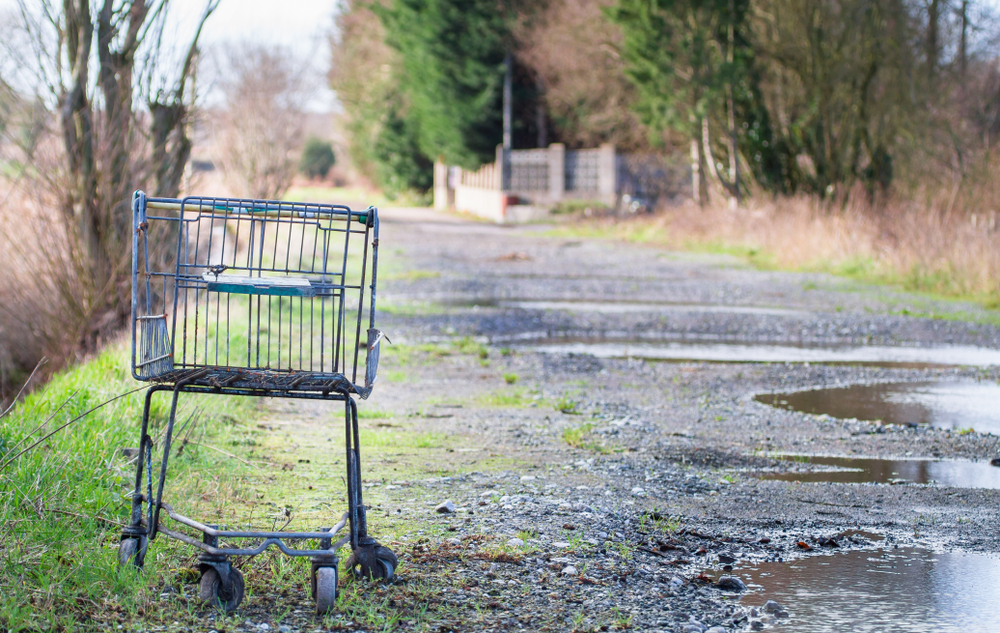
Years ago, I received a call from the manager of a local grocery store. He was frustrated, and I understood why.
He believed the Mission had his shopping carts.
Technically, we did not.
But many people came to our shelter carrying their belongings in shopping carts. They arrived looking for a meal, a shower, clothing, or for shelter. When they came inside, the carts were often left at our front door.
From the store’s perspective, the carts were missing and had ended up with us. From the guest’s perspective, the cart was a practical way to transport their belongings. From our perspective, we were standing in the middle of a problem we did not create, but could not ignore.
In addition to that, the city of Medford has an ordinance that is aimed at solving the problem of nuisance shopping carts. The majority of the burden falls on the stores who are required to post signs and create processes to retrieve abandoned carts. And if they don’t collect them in a reasonable amount of time they can be fined.
The ordinance also states that unauthorized appropriation of a shopping cart is a crime under Oregon’s theft statute.
In plain language: shopping carts belong to the stores. They are not free transportation. They are not public property. And when they disappear, someone pays the cost.
At first, the store saw us as the problem. Carts were ending up at our building, so it seemed logical to blame the Mission. But we were not taking the carts. We were feeding people, sheltering people, and offering help to people who were homeless.
Still, we took action, and it was not popular.
We started collecting abandoned carts and returning them to the stores. It cost our staff time and energy, but it felt like the neighborly thing to do. Some guests were frustrated because the carts made it easier to carry everything they owned. We explained that we were trying to care for both them and local businesses. We reminded guests that the carts belonged to the stores, encouraged them to return carts when possible, and offered to help by storing belongings or returning carts ourselves.
We tried to hold that boundary without shaming anyone, knowing that some people may have been carrying everything they owned.
People responded differently. Some understood and gladly adjusted. Others viewed any boundary as unfair. Their reactions revealed an important truth: immediate needs are real, but not every immediate solution actually helps.
I suppose we could have purchased carts at a great cost to us and handed them out, but I am not convinced that would have helped. Sure people would take them but then our carts would be abandoned around the community. You see a cart was never just a transportation issue; it reflected deeper questions about responsibility, dignity, and community.
That is where When Helping Hurts has been so helpful to us. The book offers this definition: “Poverty is the result of relationships that do not work, that are not just, that are not for life, that are not harmonious or enjoyable. Poverty is the absence of shalom in all its meanings.”
In other words, poverty is not merely the absence of material things. It is rooted in broken relationships: with God, with self, with others, and with the rest of creation. If we define the problem too narrowly, we will almost always offer the wrong solution.
Not being able to haul personal belongings in a shopping cart might seem like a transportation problem. But it was also a neighbor problem, a property problem, a responsibility problem, a dignity problem, and a community problem. If we responded only by making the immediate pressure go away, we could easily help one person while harming someone else.
There is a kind of help that gives people what they ask for in the moment but this isn’t always the best way to help. Sometimes the loving thing is not simply to remove the immediate pressure. Sometimes the loving thing is to help a person take the next responsible step, even when that step is difficult.
The shopping carts became a small picture of that larger lesson.
If we simply ignored the carts and let people continue to abandon them next to the Mission, we might be helping one person in a way that harmed another. Our guests had temporary convenience, but stores lost property, the neighborhood became a dumping ground, and the Mission inherited the conflict. Real mercy cannot ignore the wellbeing of one neighbor simply because another neighbor’s suffering is more visible.
So we chose a different path.
We returned carts. We talked with guests. We offered storage. We set boundaries. We tried to be compassionate without pretending that compassion means ignoring consequences.
The problem did not disappear immediately. It moved. Carts started showing up in alleys and streets around the Mission instead of at our front door. That was frustrating, but it also revealed something important: the carts were symptoms of deeper problems, including homelessness, instability, and the expectation that ministries and businesses should quietly absorb every cost connected to homelessness.
Then one day I received a call from a woman in the community who often took sack lunches to people in the park. Someone had told her the Mission was heartless because we would not allow people to bring shopping carts onto our property.
In her mind, we had become the bad guys.
I explained that the carts belonged to the stores, that local businesses were absorbing the cost, and that the Mission was already providing food, shelter, clothing, and storage. We were not trying to punish people experiencing homelessness. We were trying to practice compassion without ignoring responsibility to neighbors.
She still disagreed.
Her view was simple: if someone is homeless, they should be allowed to use the cart. The stores had hundreds of them. They would not miss a few.
But that is not justice. And it is not mercy either (Micah 6:8).
Mercy does not require us to pretend that someone else’s property no longer matters. Compassion for a person in poverty should not mean indifference toward a local business owner. Loving our homeless neighbors should not require us to stop loving our grocery store neighbors (Luke 10:27).
That is the hard work of ministry. We are called to love the person in front of us without creating harm for the person down the street.
At the Mission, we have never wanted to offer the kind of help that merely moves a problem from one place to another. We want to offer help that invites people toward restoration: with God, with themselves, with others, and with the community around them.
Sometimes that means helping people with basic needs.
And sometimes it means saying, “We love you, but you cannot bring stolen property onto our property. Let us help you find a better solution.”
That may not feel compassionate to everyone watching from the outside. But compassion without truth can become enabling, and truth without compassion can become cruelty (Ephesians 4:15).
Our calling is to hold both together.
Jesus did not come merely to make people more comfortable in their brokenness. He came announcing the good news of the kingdom: the restoration of all things under His loving rule (Colossians 1:19–20).
That restoration includes mercy for the poor, justice for the oppressed, truth for the confused, repentance for the sinner, reconciliation between neighbors, and dignity for every person made in the image of God.
The goal was never to protect shopping carts over people. The goal was to love people without teaching them that their need gave them permission to harm their neighbors.
The shopping carts taught us that real help is rarely as simple as it looks. A cart at the front door was not just a cart. It was a question:
Will we offer help that makes us feel kind for the moment, or help that leads toward responsibility, dignity, and restoration?
We chose the harder road.
And I believe it was the more loving one.
Love sometimes takes the form of a boundary held with grace.
Partner with us in God’s work of relational restoration.