
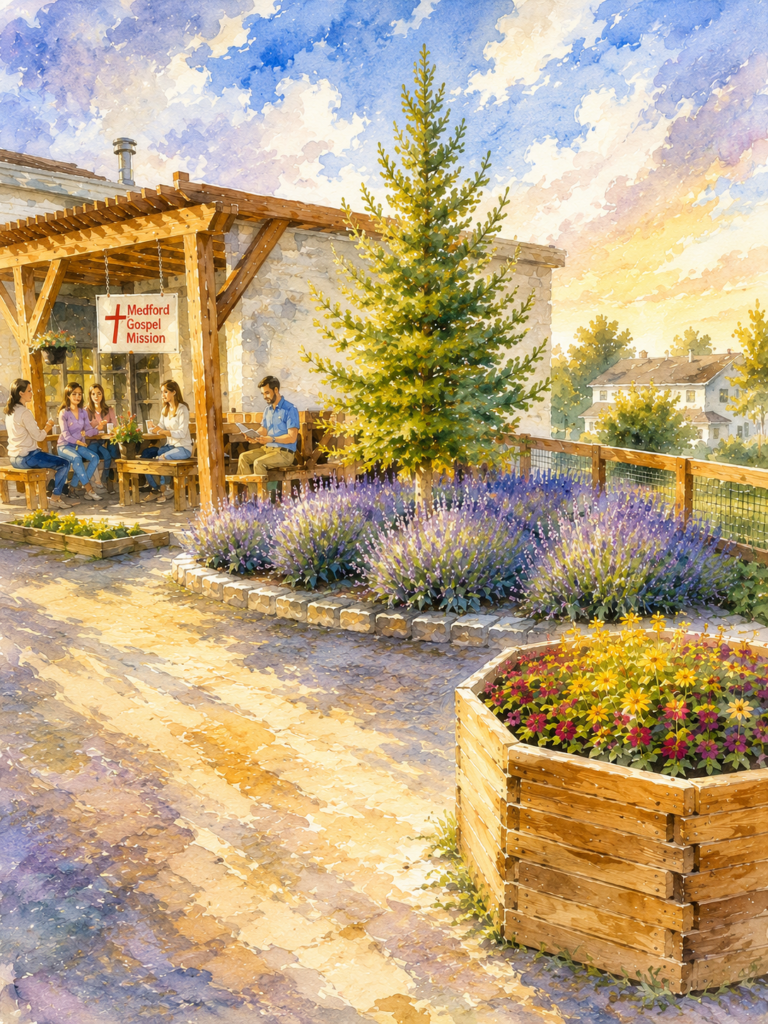
Gardens have a way of bringing people together. They offer beauty, food, work, purpose, and hope. A garden can become shared ground where people who might not otherwise know one another work side by side. It can invite patience, cooperation, and joy. At its best, a garden is a picture of community.
In fact, the Gospel Garden was created as a community project by the Medford Chamber of Commerce leadership team over a decade ago. Men and women from local businesses used their skills and connections to plan, raise funds, and execute the project over the course of a few months.
Left to ourselves, we probably would not have the garden we have today. Our garden does more than provide fresh vegetables for our meals. More importantly, it gives us a place to practice relational restoration.
But just as a garden can restore and unite, it can also reveal what is broken and divide.
At the Mission, our Gospel Garden has done both.
Over the years, the garden has taught us that community is not created simply by putting people in the same space, especially when that space is hot, dirty, and full of weeds. A garden can look productive and peaceful from the outside, but beneath the surface it can expose expectations, assumptions, frustrations, and competing ideas about ownership and purpose.
At different times, the garden drew considerable interest from the wider community. Volunteers came with a sincere desire to serve, but they also brought different ideas about how the garden should be cared for and run. Some emphasized order, productivity, planning, and particular gardening methods. Others saw it primarily as a place of relationship, welcome, and patient growth. They were united in purpose, but not always in practice.
Those differences became especially visible around participant involvement. Volunteers often hoped participants would eagerly engage, take responsibility, and discover purpose through the garden. But participants were not always able to meet those expectations. Some were tired, overwhelmed, healing, or simply trying to make it through the day. What appeared to one person as a lack of interest may actually have been a lack of capacity.
At other times, participants became deeply invested in the garden. They cared for it, protected it, and took genuine pride in their work. That ownership was a blessing, but it could also become territorial, as though the garden belonged to them and anyone else entering it was trespassing.
For participants who came to the Mission with very little, that sense of ownership is understandable. The garden gave them a place to belong. Yet even good ownership has to be shaped into stewardship. The garden could not become private property where only some people belonged.
Then there were seasons when the opposite was true. We had program participants who became deeply invested in the garden. They cared for it, protected it, and took pride in it. That involvement was a blessing. But at times, it also became territorial, almost as if the garden had become their land and others were trespassing on it.
There were also seasons when tension emerged between those who grew the food and those who cooked it. Gardeners wanted the harvest to be valued and used. Cooks needed ingredients that fit the menu, the schedule, the quantity, and the realities of feeding large groups of people every day.
The questions went both ways: “Why aren’t you growing what we need?” and “Why aren’t you using what we grow?”
Both sides had a point. The garden did not magically meet every need. It had to be connected to the kitchen through communication, planning, humility, and shared purpose. And that very tension became the soil where relational restoration could begin to take root.
Over the years, we have learned that gardens are ripe for challenges. They require people to share more than soil and harvest. They require us to share expectations, authority, responsibility, disappointment, gratitude, and grace.
The Gospel Garden has grown vegetables, but it has also grown valuable lessons.
It has shown us that people may be united by a mission and still divided by methods. It has shown us that ownership can bring dignity, but also conflict. It has shown us that meaningful work requires more than good intentions. It requires listening. It requires coordination. It requires patience.
Most of all, the garden has reminded us that growth takes time.
That is true in the soil, and it is true in people.
Maybe the Gospel Garden is most “Gospel” not when everything runs smoothly, but when it becomes a place where grace is practiced. Grace when people disagree. Grace when people do not meet our expectations. Grace when people care deeply but need help learning shared stewardship. Grace when we aim to serve the whole community together.
A community garden is never just a garden. It is a mirror. It shows us who we are, what we value, where we struggle, and how much we still need to grow.
And perhaps that is part of its gift.
Partner with us in God’s work of relational restoration.