
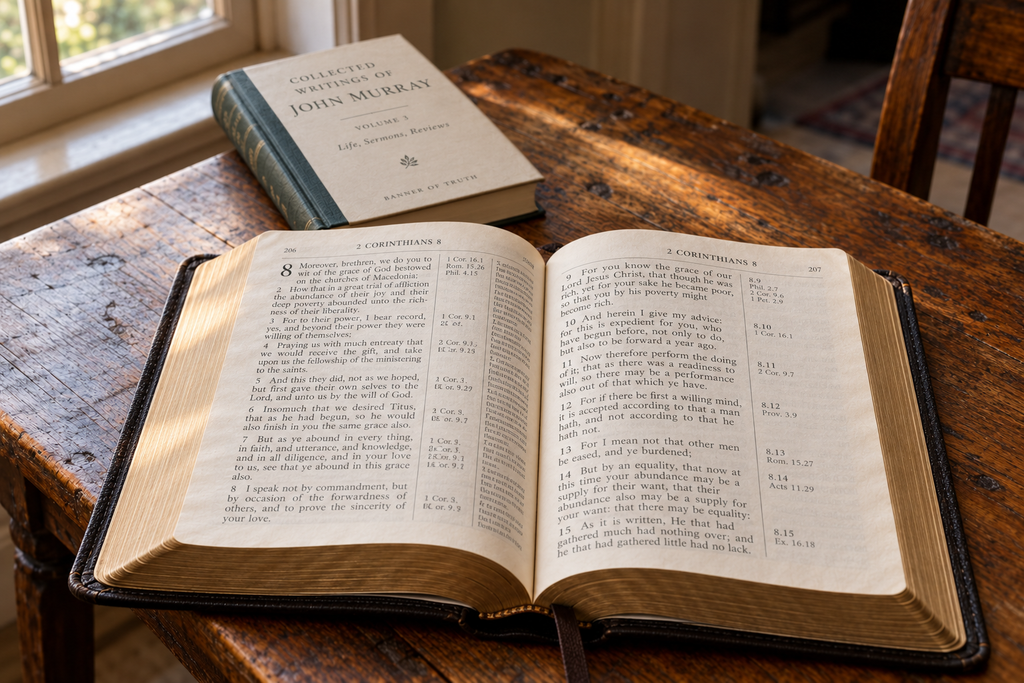
“When he became a man, he did not cease to be rich in his divine being, relations, and possessions. He did not become poor by ceasing to be what he was, but he became poor by becoming what he was not. He became poor by addition, not by subtraction. He added manhood to his immutable and eternal Godhood. He added to his person real human nature with all its sinless properties and necessary infirmities. He was made in the likeness of men.”
—John Murray, Collected Writings of John Murray, Volume 3, “The Riches and the Poverty of Jesus Christ,” p. 231, Banner of Truth.
When we think about poverty, we naturally think about the circumstances around us: rising prices, economic uncertainty, homelessness, and the social debates of the day that can make it seem as though things have never been worse. These concerns matter. But they can also become the lens through which we read Scripture, shaping what we expect it to say.
Theologian John Murray was no stranger to troubled times. Born in 1898, he lived through two world wars and the Great Depression. He also knew suffering firsthand, having lost his right eye after being wounded while serving in World War I.
In explaining Paul’s words in 2 Corinthians 8:9, Murray begins with Christ Himself. His reflections offer a helpful starting point for our own, directing our attention to the identity of the One who became poor. Before we can understand Christ’s poverty, we must consider His riches.
The apostle Paul writes, “For you know the grace of our Lord Jesus Christ, that though he was rich, yet for your sake he became poor, so that you by his poverty might become rich” (2 Corinthians 8:9).
Jesus Christ is the eternal Son of God. All things were created through Him and for Him. His riches cannot be measured in money or possessions. They belong to who He eternally is.
Becoming human involved no loss of His deity. He remained fully God. As Murray explains, He became poor “by addition, not by subtraction.” The Son took to Himself a complete human nature.
He entered our world as an infant who needed to be fed, clothed, and held. He grew tired. He became hungry. He wept at a friend’s grave and experienced rejection from people He had come to save. His humanity was real, and so was His suffering. Yet through it all, He remained without sin.
His humiliation led Him to the cross where He took the place of sinners, bearing the judgment we deserved. This is why Paul says He became poor “for your sake.” Christ’s poverty served our redemption.
The riches He gives us include forgiveness, reconciliation with God, adoption into His family, and everlasting life. These gifts cannot be purchased or earned. We receive them through faith in the Savior who gave Himself for us.
What does this have to do with the poverty we see around us? Paul makes the connection himself. He speaks of Christ becoming poor while encouraging the Corinthians to give toward the needs of other believers. The grace they had received was to shape their generosity.
That same grace shapes how we respond to poverty today. Having received so much from Christ, we learn to pay attention to the needs of others and share what we have. Giving can be a meaningful expression of love for people made in God’s image.
At the Mission, the men and women in our program learn to care for themselves and recognize what they have to offer others. Through shared responsibilities, friendship, Scripture, and relationships with local churches, they discover ways to use their gifts to serve. This is part of growing in their relationships with God, themselves, others, and creation.
Whatever our financial circumstances, we all need the reconciliation with God that Christ alone provides. Those of us offering help depend on the same grace we seek to share. As we grow in that grace, we too learn to receive from others and use our gifts to serve.
Murray’s explanation gives our generosity a deeper foundation. We give as people who have received abundantly from Christ. That gives us reason to approach others with humility, take their needs seriously, and recognize the gifts they have to share as well.
To understand how Christ became poor, we begin with who He is and what He has done. As we receive the riches of His grace, we learn to care for one another with what God has entrusted to us.
Paul Levy’s article, “Jesus and Poverty,” introduced me to the John Murray quotation above and prompted further reflection on what it means that Christ became poor for our sake.
Scripture quotations are from the ESV® Bible (The Holy Bible, English Standard Version®), © 2001 by Crossway, a publishing ministry of Good News Publishers. ESV Text Edition: 2025. The ESV text may not be quoted in any publication made available to the public by a Creative Commons license. The ESV may not be translated in whole or in part into any other language. Used by permission. All rights reserved.
Partner with us in God’s work of relational restoration.