
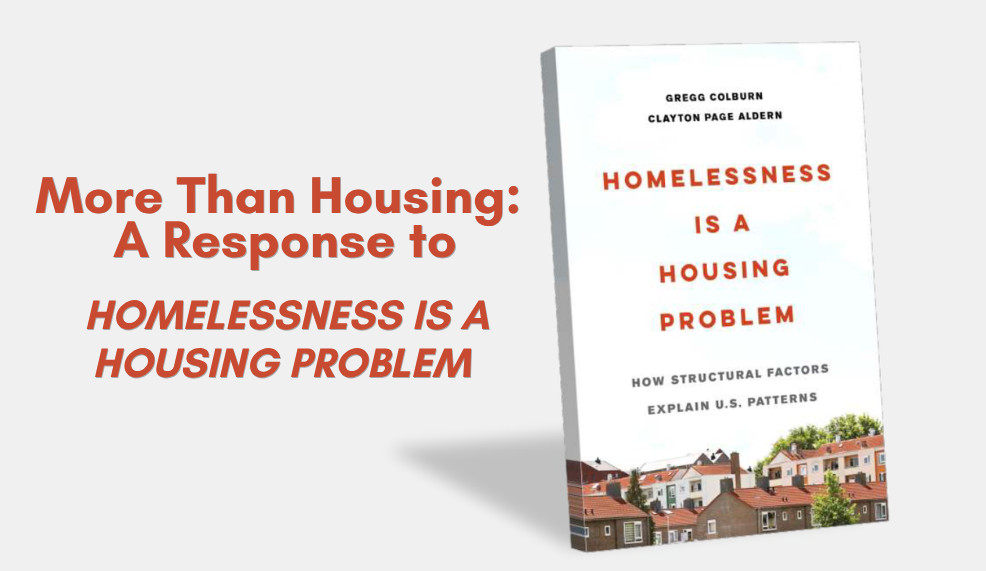
I have spent nearly thirty years working full-time with people experiencing homelessness. Over those years, one thing has become very clear to me: there is no simple blueprint that solves every problem for every person. Homelessness is complicated because people are complicated.
More importantly, people are not problems to be solved, fixed, or managed. They are image bearers of God, carrying a dignity no hardship can take away. However broken a life may seem, that story is not over. None of us is finished. We are all people in need of grace, all being restored in ways seen and unseen.
A few months ago, I learned that one of the authors of Homelessness Is a Housing Problem was coming to Southern Oregon. He is widely regarded as an expert on homelessness. If I am honest, my first reaction was annoyance. Not because housing is unimportant. It is deeply important. But homelessness is not simply a housing problem, and reducing it to that felt like it overlooked too much of what I have witnessed over nearly three decades of ministry.
I am not a nationally known expert, academic, or statistician. I am simply a man in Southern Oregon who has spent most of his working life helping people out of homelessness. But I have walked alongside enough people in crisis to know that homelessness is rarely the result of just one thing. More often it is a tangled mix of broken relationships, trauma, addiction, mental illness, destructive choices, economic hardship, and spiritual lostness. In the lives of the people I have known, homelessness is rarely a housing problem in and of itself. Housing matters, but housing alone does not tell the whole story.
That is why I wanted to take Homelessness Is a Housing Problem seriously. Rather than dismissing it out of irritation, I wanted to read it carefully, understand what the authors were actually arguing, and then ask whether their framework is large enough to account for the reality of homelessness as I have come to know it.
To be fair, the authors make an important contribution. They are not careless writers, and they do not argue that every individual becomes homeless for exactly the same reason. In fact, they carefully narrow their focus and say, “This is a book about cities, not individual people.” Their central argument is that the striking differences in homelessness from one city to another are best explained by housing-market conditions, especially rent levels and vacancy rates. They are also critical of explanations and policy responses that treat addiction, mental illness, abuse, trauma, or other forms of brokenness as the primary reason some cities have more homelessness than others.
They are right to insist that the housing market matters, and they are right to challenge explanations that reduce homelessness to a single personal failure. But I am not persuaded that the contrast is as neat as they suggest. Cities differ not only in housing costs, but also in addiction, mental illness, family breakdown, policing, the quality of outreach, and the broader social and cultural conditions that shape all of those realities. I do not think those factors can be pushed to the edges as easily as this book sometimes implies.
This is why I believe the title says more than the book can fully support.
The book helps explain where homelessness is concentrated. But it does not attempt to explain homelessness in the fullest human sense, and that leaves important parts of the picture outside its frame. Why does this particular person fall into homelessness? What actually helps someone attain and sustain housing over time? Those questions are too important to be treated as secondary. That, to me, is the heart of the problem. The book asks a narrower question than its title suggests, and at points its conclusions feel broader than its evidence can fully sustain.
For that reason, I want to approach this book by asking three questions:
First, why do some cities have more homelessness than others?
Second, why does a particular person become homeless?
Third, what actually helps a person move toward lasting restoration?
The authors are strongest on the first question. They are thinner on the second. And on the third, they move beyond what their own evidence can really establish.
Start with the first question: why do some cities have more homelessness than others?
Here the book offers a real corrective. The authors are right to challenge the reflexive assumption that homelessness can be explained simply by pointing to drugs, mental illness, or personal failure. They are right to show that high rents and low vacancy rates place enormous pressure on vulnerable people. They are right to argue that some cities make it much harder to remain housed than others do. Their city-level argument deserves to be heard.
That rings true to what I have seen over three decades of work in our community. A tight housing market can make a fragile life even more fragile. When someone is living paycheck to paycheck, one crisis can push him over the edge. Even for men and women who have done the difficult work of rebuilding their lives, finding affordable housing can still be painfully hard. Housing pressures are real, and any honest response to homelessness has to take them seriously.
But that is only the first question.
The second question is different: why does a particular person become homeless?
Here, the authors’ own clarification becomes crucial: this is a book about cities, not people. Fair enough. But those of us who actually work with people experiencing homelessness do not serve cities directly. We serve men and women. We sit across from real people with names, histories, wounds, habits, fears, and hopes. And at that level, homelessness rarely has only one cause.
The people I have known through the years are not merely victims of market conditions. They are whole persons whose lives are shaped by relationships with God, self, others, and the world around them. When those relationships fracture, the outward consequences can take many forms: addiction, trauma, untreated mental illness, broken families, shame, despair, isolation, destructive habits, and spiritual confusion.
To be clear, this book does not deny these realities. It treats them as individual “vulnerabilities.” But because the book’s method is designed to explain regional variation, it necessarily pushes much of this to the side. That may make sense for a certain kind of analysis. But it also means the book cannot finally bear the weight of its bold assertion that “homelessness is a housing problem.”
A book written to explain why Seattle has more homelessness than Cleveland is not sufficient to explain why real people lose their housing, keep cycling through crisis, or struggle to hold onto stability even when housing is available. For those questions, we need a more personal and more humane account of what it means to be human, how lives break down, and what true restoration requires.
And that brings us to the third question: what actually helps a person move toward lasting restoration?
This is where my deepest concern lies.
The authors do not stop with the claim that housing-market conditions help explain regional variation. They also move toward the larger claim that housing is the cure for homelessness. In one limited sense, of course, that is true. A person without housing needs housing. Shelter matters. Safety matters. Stability matters. A roof over one’s head can be a real mercy.
But mercy is not the same thing as fullness.
Stabilization is not the same thing as restoration.
An apartment cannot make a man sober.
A housing voucher cannot heal trauma.
A lease cannot restore a broken family.
A key cannot produce honesty.
A roof cannot cast out despair.
A subsidy cannot save a soul.
Housing may be necessary. In many cases it is urgently necessary. It is often a crucial part of the answer. But it is not sufficient for the deeper kind of healing every person needs.
That matters because homelessness is not experienced only as a lack of shelter. It is often experienced as shame, humiliation, fear, powerlessness, isolation, and hopelessness. A person may receive housing and still remain trapped in addiction, estranged from family, ruled by despair, and unable to imagine any meaningful future. A person can be housed and still be deeply unwell.
That is why it is important to distinguish between relief, rehabilitation, and development. Housing can be part of relief. Housing can be part of rehabilitation. It can help create the conditions in which deeper growth and development become possible. But by itself it does not rebuild trust, heal shame, renew responsibility, restore relationships, or reconcile a person to God and neighbor.
So my concern is not that this book values housing too highly. It is that it may value people too narrowly.
As Christians, we should be especially careful here. Systems and patterns may help us understand the problem, but they are not our primary calling. We are called to serve people. We serve the man whose addiction ruins every opportunity placed before him. We serve the woman trying to survive the wreckage of abuse. We serve the person whose untreated mental illness makes stability very hard to sustain. We serve men and women whose lives carry the weight of both sins suffered and sins committed.
People need more than placement. They need restoration.
And from a Christian perspective, that restoration is not merely an outcome delivered by a policy system. It is nurtured slowly, relationally, and patiently in communities of truth, grace, accountability, love, and hope. People need more than services. They need community. They need to be known. They need to be challenged and loved. They need help becoming whole.
So is homelessness a housing problem?
In part, yes. Housing market pressures can be a driver, and in some places a major driver, of why homelessness is more severe in some places than in others. The book is right to insist on that, and we should be grateful for the clarity it brings there.
But homelessness is not simply a housing problem.
The book is strongest when it explains why homelessness is concentrated in certain places. It is less convincing when it moves from that narrower question to larger claims about homelessness itself. It offers a strong account of one important structural reality, but it does not finally give us an adequate account of the human condition of homelessness or the path toward healing. Housing can be necessary without being sufficient. Stabilization, important as it is, should never be mistaken for restoration.
After all these years, I still cannot think of homelessness as an abstract policy issue. I see faces. I hear names. I remember conversations, setbacks, funerals, relapses, prayers, and the amazing grace God gives to change lives.
That is why I cannot settle for explanations that are too small. Housing matters, and I am grateful for anything that helps us see that more clearly. But the people I have known needed more than a place to sleep. They needed truth, grace, structure, love, and hope. They needed someone to believe they were worth fighting for.
They needed restoration.
Like all image bearers do until we are truly home.
Partner with us in God’s work of relational restoration.