
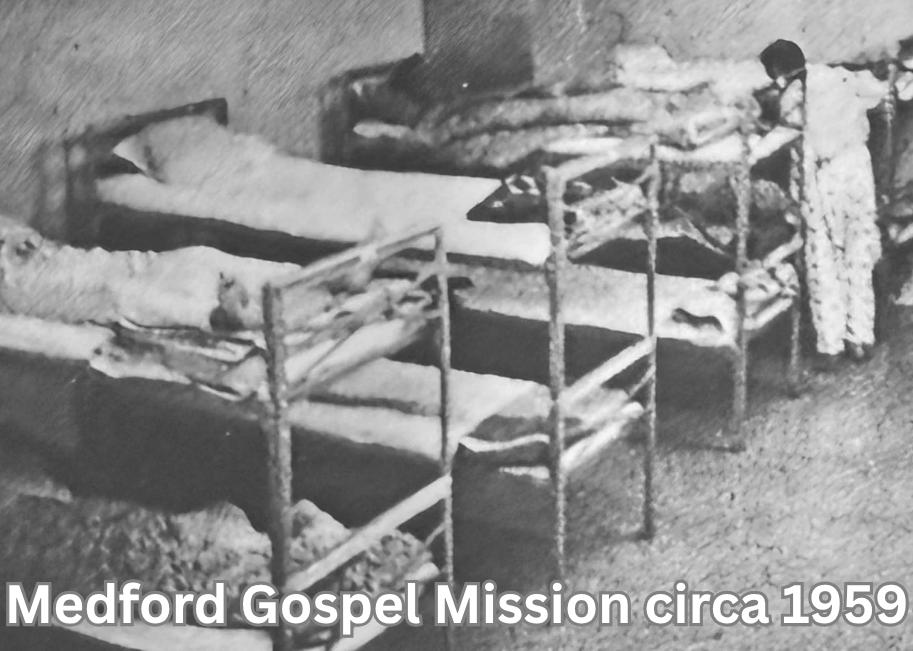
The Medford Gospel Mission began in 1959, when local churches came together to address a problem in the Rogue Valley that was being ignored. People in our community were facing poverty, addiction, homelessness, and spiritual darkness. From the beginning, the Mission existed to care for people both physically and spiritually.
For many years, one of the clearest expressions of that compassion was our emergency shelter. When someone had nowhere else to go, the Mission offered refuge. A bed mattered. A meal mattered. Safety mattered. In moments of crisis, shelter could mean the difference between despair and survival.
That work was urgently needed. The Mission became one of the longest-standing homeless service providers in Jackson County and, at one time, one of the only shelters in Southern Oregon. We carried a responsibility that few others were willing or able to bear.
But one thing was always true: we never believed that a bed, by itself, was enough.
Even while we provided emergency shelter, we were never committed to relief services alone. Alongside emergency services, the Mission operated restoration programs designed to help men and women address the deeper issues that had contributed to their homelessness in the first place. Our goal was never simply to help people survive one more night. Our goal was to help people move toward a restored life.
Over time, however, two realities became impossible to ignore.
First, the broader homelessness response system changed. As public policy shifted, homelessness services became increasingly shaped by government funding and the priorities attached to it. The emphasis moved toward lower-barrier shelter, rapid rehousing, housing-first strategies, and harm reduction. The focus increasingly centered on immediate shelter and housing access rather than the deeper work of life change.
That shift mattered because it reflected an understanding of homelessness work that was moving farther away from the Mission’s convictions and from a Christian worldview concerning human nature, responsibility, and restoration.
The Medford Gospel Mission has always taken a different path than most other nonprofits. We operate through private support from individuals, churches, businesses, and, only occasionally, foundations. We do not accept city, state, or federal government funding.
That independence matters because funding is never just money. It carries assumptions, rewards certain approaches, and pressures nonprofits to follow the priorities of those providing it. Remaining privately supported has allowed the Mission to pursue a distinctly Christ-centered ministry without dependence on government systems or government priorities.
Second, we came to see that emergency shelter and long-term development cannot successfully exist in the same place.
This was not merely a philosophical conclusion. It was something we learned through experience. The environment required for emergency shelter is not the environment required for restoration and development. Emergency shelter necessarily brings instability, unpredictability, and disruption. People arriving in immediate crisis may truly need refuge, but they are not always ready for the structure, accountability, and deeper work that long-term change requires.
Men and women who are trying to rebuild their lives need an environment that is safe, stable, orderly, and conducive to growth. They need space for honesty, responsibility, discipleship, healing, and the opportunity to thrive. When emergency shelter and long-term development are combined in the same place, that environment becomes unstable and the deeper work is weakened.
That forced a question: What is the Mission uniquely called and best equipped to do?
Emergency shelter and relief services matter. In moments of crisis, they can be necessary, merciful, and life-preserving, and we were actively involved in that work for more than sixty years. But relief is not restoration, and restoration is not development.
Relief stabilizes a crisis. Restoration begins to address what is broken. Development goes further. It helps people build new patterns of life over time—patterns marked by truth, responsibility, healthy relationships, spiritual growth, work, stability, and meaningful connection to church and community.
The Mission has long believed that people need that deeper kind of help. Through decades of shelter work, we learned something that became impossible to ignore: a man can be indoors and still be enslaved. A woman can have a roof and still be broken. A person can be sheltered and still be lost.
Emergency shelter served a real purpose, and we are grateful for that history. But shelter has limits. A bed can offer rest for a night, but it cannot heal the restlessness of the soul. A meal can ease a crisis for an evening, but it cannot form responsibility. A roof can protect someone from the rain, but it cannot restore what sin has broken. And no shelter program, by itself, can reconcile a sinner to God.
At the same time, the community around us changed. When the Mission first opened, emergency shelter was one of the few responses available. Today, far more public resources and organizations are devoted to relief work, lower-barrier access, housing programs, and other immediate services.
So in 2020, in the midst of COVID-19 and while more government money than ever was coming into our community, we took the opportunity to think strategically about our role and how we could make the greatest impact. We concluded that we should stop emergency shelter and focus on those ready to pursue restoration and development.
We made that change because the broader system had changed, because the priorities driving shelter work were drifting away from our convictions, because the community now had many other relief providers, and because we had become convinced that emergency shelter and long-term development could not successfully coexist in the same setting.
We also became persuaded that our clearest contribution was not to duplicate the relief work many others now provide, but to devote ourselves more fully to the long-term Christ-centered development that stands at the center of our ministry.
Today, that conviction shapes our work openly and intentionally. The Mission exists to reach our community with the Gospel and to equip people to make positive changes in their lives through Christ-centered programs and services. We are not a church, but a parachurch ministry rooted in the Gospel and committed to helping people move toward lasting transformation and into the believing community of local churches.
The Mission’s story is not that we abandoned compassion. It is that we refused to let compassion be reduced to short-term relief.
Real compassion does not only ask, “How do we get someone inside tonight?” It also asks harder questions: How does this man become honest? How does this woman learn responsibility? How are broken relationships repaired? How are destructive patterns confronted? How does someone grow in stability and purpose? How is a lost sinner reconciled to God?
Those are the questions that shaped the Mission in 1959, and they are still the questions that shape us today.
So yes, emergency shelter is a major part of our history. It should be honored. It should be remembered. It was one of the most visible ways the Mission loved this community for many years.
But it was never the whole story.
The deeper story is that the Mission has always believed there is a path out of homelessness that goes deeper than shelter and deeper than housing. That path is harder. It requires truth, responsibility, work, discipleship, grace, and community. But it is also the path that leads to lasting change.
That is why our ministry looks different today.
Not because homelessness disappeared.
Not because emergency shelter never mattered.
Not because we grew cold.
But because after decades of shelter work, and in a community where many others now provide relief, we became more certain than ever that people need more than a bed.
They need the Gospel.
They need truth.
They need relationships.
They need responsibility.
They need a church community.
They need the kind of long-term development that leads to lasting change.
And by God’s grace, that is what the Medford Gospel Mission is still here to pursue.
Partner with us in God’s work of relational restoration.