
Best practices are supposed to be exactly what the name suggests: practices shown to produce the best results. It makes sense, then, that organizations receiving government grants would be expected to follow them. If public money is being spent, there should be some confidence that the methods being funded actually work.
At the Medford Gospel Mission, we do not receive government grants, so we have a different relationship with so-called best practices.
We do not follow many of the accepted best practices for addressing homelessness. That is not because we are unaware of them or unconcerned about the effectiveness of our work. We question them because they often grow out of a different understanding of people, what has gone wrong in their lives, and what it means for them to be restored.
Years ago, at a community meeting, a city commissioner asked whether we followed best practices at the Mission. I told him rather flippantly that many of the accepted best practices were almost exactly the opposite of what we did.
That probably sounded stubborn. If experts had already identified the most effective approaches, why would a Christian ministry choose a different path?
The answer begins with a question that is too often left unasked: Best at accomplishing what?
No practice can be called best until we have decided what result we are trying to achieve. A program may be effective at placing someone in housing or reducing an immediate danger. Those are real outcomes, and they may be genuine acts of mercy. But they are not the same as personal responsibility, restored relationships, belonging in a healthy community, or reconciliation with God.
My concern with many accepted best practices has never been only about methods. The disagreement runs much deeper. It begins with a different understanding of the person, what has gone wrong, and what true restoration should look like.
When “Best” Changes
For years, organizations addressing homelessness were told that Housing First and harm reduction represented best practices. These approaches shaped government policy, grant requirements, social-service training, and local ten-year plans to end homelessness, plans whose deadlines have long since passed. Organizations seeking federal funding had powerful reasons to bring their programs into alignment.
Now the United States Department of Housing and Urban Development is changing direction.
HUD is moving away from its previous emphasis on Housing First and toward Treatment First, recovery, self-sufficiency, transitional housing, supportive services, and accountability. In August 2026, HUD, the Department of Health and Human Services, and the Office of National Drug Control Policy released the Best Practices Toolkit: Addressing Homelessness and Addiction Through Treatment First. [1]
Federal policy can designate one approach as a best practice under one administration and elevate a markedly different approach under another. That alone should make us cautious about treating the phrase as though it represents a permanent and morally neutral scientific verdict.
The people experiencing homelessness did not suddenly change. Addiction did not change. Human nature did not change. The presidential administration changed and with it, the priorities guiding billions of dollars in federal funding.
That does not prove that either administration was right simply because it held power. It reveals something more basic: public policy always rests upon judgments about which problems matter, which outcomes count, and what human flourishing looks like.
So what happens when yesterday’s best practice is no longer considered best?
When Funding Defines What Is Best
Faith-based organizations are, in theory, eligible to apply for many government grants. But receiving a grant normally means agreeing to the requirements attached to it. Those requirements may define the services that can be provided, the methods that must be followed, and the outcomes that will be measured.
Government funding does more than pay for services. It can help define the problem, prescribe the acceptable solution, and determine what counts as success.
Over time, the funded practice becomes the common practice. It is implemented, studied, taught, and built into grant requirements until it comes to be known as the best practice. Organizations that question it may then appear uninformed or unwilling to follow the evidence, even when their deeper concern is with the way effectiveness has been defined.
This creates a serious tension for a Christian ministry. What happens when the practice required by a grant conflicts with what we believe is faithful to God and His purposes? The ministry may legally remain Christian, yet its publicly funded work must still conform to the philosophy, boundaries, and objectives of the grant.
I explored that tension more fully in an earlier article, “When Government Funds Christian Ministry, Whose Definition Governs?”. The concern is not that every government-funded practice is wrong. Nor does it mean that Christian ministries should reject research or professional knowledge. The concern is that funding always comes with definitions, and those definitions may not be ours.
At the Mission, our independence from government funding gives us the freedom to ask a more fundamental question. We can evaluate every practice according to Scripture rather than reshaping our ministry whenever political priorities and grant requirements change.
Every Practice Tells a Story
The Chalmers Center describes the assumptions underlying a particular approach as its “story of change.” Every effort to help people contains such a story, whether it is openly acknowledged or not. [2]
A story of change answers basic questions about what human beings are for and how genuine change takes place. Fikkert and Kapic summarize the framework with two foundational questions: “What is the goal of life?” and “How can this goal be achieved?”
Drawing on that framework, we can organize God’s story of change around four basic questions: [3]
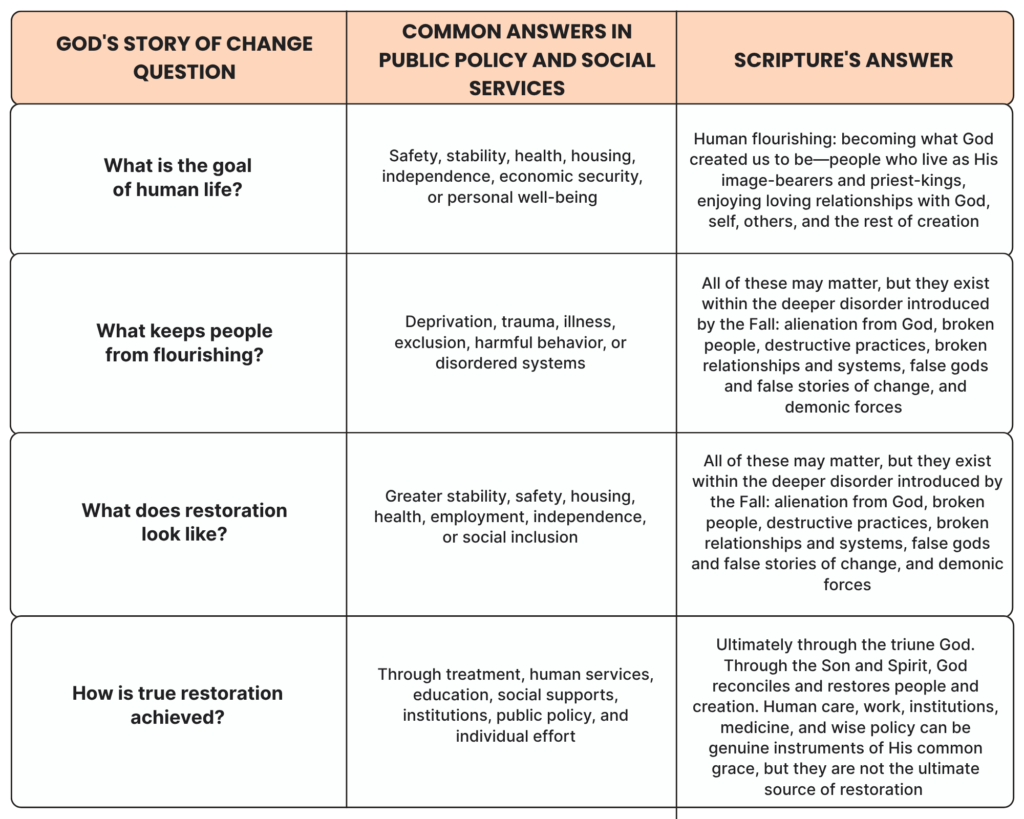
The differences in this chart do not mean that safety, housing, treatment, employment, or mental health care are unimportant. Each may address a real need and serve as a genuine expression of mercy. The problem comes when one of these partial goods is treated as the whole of restoration.
These questions also bring together the themes explored throughout our Attacking the Roots series. Human brokenness cannot be traced to one cause or repaired by one material solution. False stories of change, broken people, destructive practices, broken systems, and demonic forces interact with and reinforce one another. Genuine restoration must therefore address the whole person.
Sobriety matters. Work matters. Housing matters. Mental health care may matter enormously. Reconciliation with family matters. None of these is redemption, but none becomes meaningless simply because it is not redemption.
My concern is not that secular approaches care too much about material needs. It is that material solutions are sometimes asked to carry a weight they cannot bear. A person’s circumstances may improve while serious brokenness within the person, in their relationships, in the systems surrounding them, or in their relationship with God remains unaddressed. [4]
Testing What the World Calls Best
At the Mission we have a more reliable authority than professional consensus. We have the Word of God.
Paul writes:
“Do not be conformed to this world, but be transformed by the renewal of your mind, that by testing you may discern what is the will of God, what is good and acceptable and perfect” (Romans 12:2, ESV).
That command applies to our work just as surely as it applies to individual Christians. We cannot allow the philosophies governing the world around us to define compassion, freedom, human flourishing, or successful change for us. Our thinking must be renewed by God’s Word so that we can discern what is truly good.
This does not require us to reject research, the experience of others, or insights from people who do not share our faith. God allows people to discover real truths about His world, and we should receive what is useful with gratitude.
But we must also test it.
Secular research and accepted best practices can help us better understand trauma, addiction, housing, mental health, and social systems. But they cannot finally tell us what a human being is for.
That question belongs to God.
We are not free to reshape Scripture to fit current best practices. We must evaluate every practice in the light of Scripture and ask whether it serves God’s story of change.
Relational Restoration Is Our Best Practice
Years ago, when that city commissioner asked whether the Mission followed best practices, I answered that many of the accepted best practices were almost exactly the opposite of what we did.
I might answer differently today.
I would begin with a question: “Best at accomplishing what?”
Then I would explain that relational restoration is our best practice because we believe people were created for loving relationships with God, self, others, and creation. Sin has brought disorder into each of those relationships, and true human flourishing grows as they are restored according to God’s design.
Only Jesus Christ can reconcile a person to God. Our programs cannot save anyone. But everything we do should serve a larger vision of truthful mercy and genuine restoration. That includes responsible living, meaningful work, healthy relationships, belonging to the local church, and hearing the good news of Jesus Christ.
This is why our practices sometimes look different from those of other nonprofits in our community. We are not pursuing a different method merely for the sake of being different. We are working from a different story of change.
Best practices can help us sharpen our work, protect the people we serve, and recognize weaknesses that need to be corrected. But they cannot be our final authority.
Best practices change.
The Word of God does not.
[1] U.S. Department of Housing and Urban Development, “ONDCP, HHS, and HUD Launch First-Ever ‘Treatment First’ Toolkit to Combat Homelessness and Addiction,” August 12, 2026.
[2] Brian Fikkert and Kelly M. Kapic, A Field Guide to Becoming Whole: Principles for Poverty Alleviation Ministries, chap. 1.
[3] Adapted from Brian Fikkert and Kelly M. Kapic, Becoming Whole: Why the Opposite of Poverty Isn’t the American Dream, chaps. 1–2, 6–10; and Fikkert and Kapic, A Field Guide to Becoming Whole, chap. 1 and appendix.
[4] Steve Corbett and Brian Fikkert, When Helping Hurts: How to Alleviate Poverty Without Hurting the Poor . . . and Yourself, chap. 2; Fikkert and Kapic, Becoming Whole, chaps. 1, 3, and 10.
Partner with us in God’s work of relational restoration.