
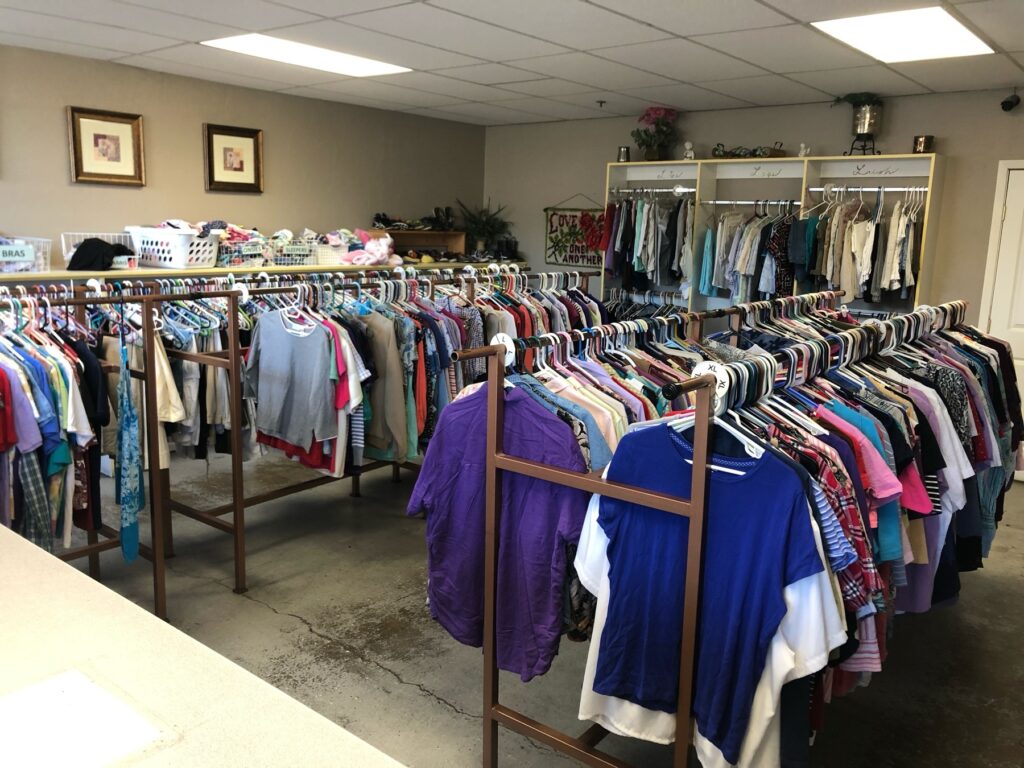
The Outfit Outlet Story – Relief, Restoration, and the End of a Season
Outfit Outlet was not born out of strategy.
It was born out of overflow.
In 2008, the economy shook everyone’s pocketbooks. Financial giving declined, as it did for many nonprofits. Yet even in a lean season, people still wanted to give.
And they did.
That summer, clothing donations poured in — far more than we could possibly use. At the time, we operated two small clothing closets: one at the men’s shelter and one at the women’s shelter. Both served an important purpose, but neither was designed to handle the volume we were receiving. Bags stacked up. Storage areas filled. We had more clothing than we knew what to do with.
At the same time, volunteers stepped forward offering their time.
So we called a meeting.
The first idea was to open a thrift store. But selling donated items didn’t feel right. These gifts had been given to serve people in need.
Then a volunteer asked a simple question that changed everything:
“Why can’t we open a free thrift store?”
We met repeatedly — discussing layout, hours, policies, the name, even the sign. Volunteers searched the community for clothing racks. When they couldn’t find enough, one volunteer built some by hand.
Forty-five days after that first meeting, we opened the doors.
We went from two small shelter closets to an entire store.
And they came.
Not just homeless individuals, but families across the community — people hit hard by the recession, seniors on fixed incomes, single parents stretching paychecks. The need was broader than we realized.
But we learned hard lessons.
We saw clothing resold online. Near-new items appeared at garage sales and consignment shops. We wrestled with boundaries — how much should one person receive? How do you protect generosity without becoming guarded?
As the years progressed, the challenges were no longer just internal policy questions.
Across the West Coast, retail environments were changing. Major chains were closing locations in cities like Portland, Seattle, San Francisco, and Los Angeles. News reports documented rising shoplifting, organized retail theft, vandalism, aggressive behavior toward staff, and the growing cost of security and cleanup. Store after store cited safety concerns and unsustainable loss as reasons for closing.
Public-facing spaces were becoming harder to operate.
We experienced that same shift.
Outfit Outlet, though free and volunteer-powered, was still a retail-style environment. And we began encountering the same patterns — dangerous behavior, theft, vandalism, and break-ins.
We were broken into numerous times. Items were stolen in the night. Windows and doors required repair. Some individuals came in during open hours not to receive help, but simply to steal — even though the clothing itself was free. The issue was not access. It was conduct.
Volunteers who had built the ministry with joy now had to think about safety. Staff had to consider risk. Insurance claims and police reports became part of what had once been a simple act of generosity.
What was happening to major retailers up and down the West Coast was happening, on a smaller scale, to us.
And it forced a deeper question: if even well-resourced corporations were struggling to maintain order in open-access retail models, what did that mean for a volunteer-driven free clothing store?
At the same time, more nonprofits became involved in homelessness services. Additional clothing closets opened. We became one of many providers.
Ironically, we were often the easiest to access.
But in 2020, the Mission itself made a significant shift.
We stepped away from providing emergency shelter, choosing to focus more intentionally on restoration and development — long-term life change rather than short-term stabilization.
That shift forced us to evaluate every part of our ministry.
Outfit Outlet included.
Most people came in, went straight to the racks, gathered items, and left. There was little conversation. Little relationship. Little opportunity to address deeper needs.
Then came a moment of clarity.
In a community meeting, the Chief of Police shared that the city was spending thousands of dollars multiple times each year cleaning up the Greenway — removing discarded tents, clothing, and debris left behind.
He asked, “Where are people getting all of this stuff — and why do they just leave it?”
In that moment, it occurred to me that much of the clothing was probably coming from Outfit Outlet.
If something is easily replaced, it is often easily discarded.
I apologized in that meeting and committed to evaluating our part.
Over the following months, we tried adjustments. We placed staff on the floor to engage people in conversation. Often the response was hostile. We experimented with other models.
Eventually, we closed to walk-ins and moved to appointment-only.
The goal was relationship.
And the numbers changed dramatically.
We went from serving dozens of people a day to only a handful a week.
Did we still have clothing? Yes.
Did we still have time? Yes.
Were people interested in restoration and development?
Not many.
Relief draws a crowd.
Restoration draws the willing.
The smaller numbers clarified something important. Many were interested in provision, not participation.
Today, the Outfit Outlet as it once operated is no longer part of our ministry model. The sign has come down. The space has been repurposed.
But generosity has not stopped.
We still receive clothing donations — and we still need them. Nearly 30 men and women are in our residential programs at any given time. Clothing remains a practical need for those committed to rebuilding their lives.
When donations exceed what our program participants can use, we pass them along to trusted community partners structured to provide emergency relief clothing.
Relief still matters.
It simply is not our primary assignment.
Outfit Outlet was a meaningful season. It began in 45 days during economic uncertainty. It served thousands. It endured cultural shifts. It faced the same pressures affecting retailers across the West Coast. It taught us about generosity, boundaries, unintended consequences, safety, and alignment.
The racks are gone.
The sign is down.
But the lessons remain.
It was never ultimately about clothing.
It was about learning how to serve in a way that truly restores.
Partner with us in God’s work of relational restoration.